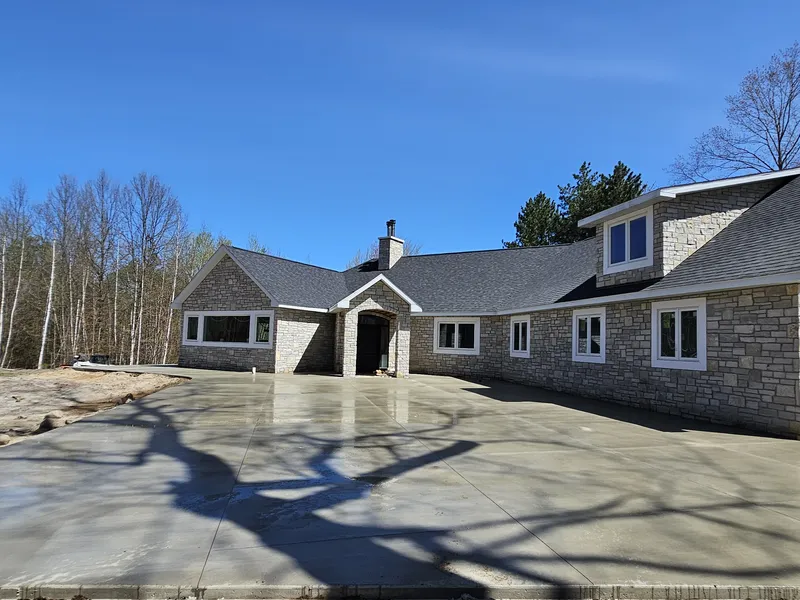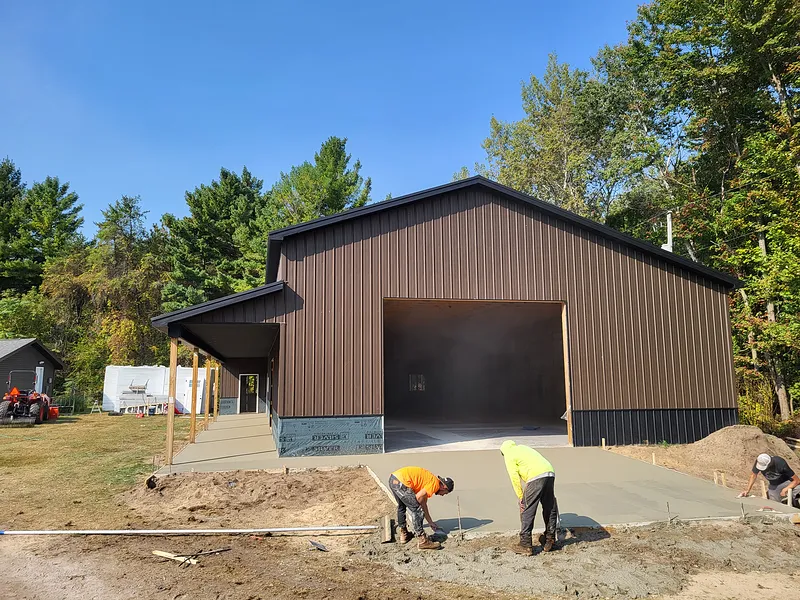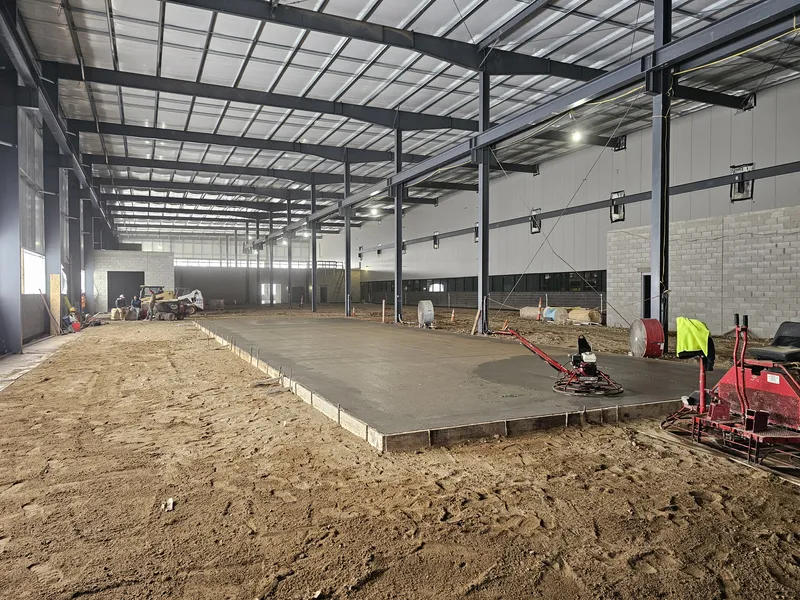
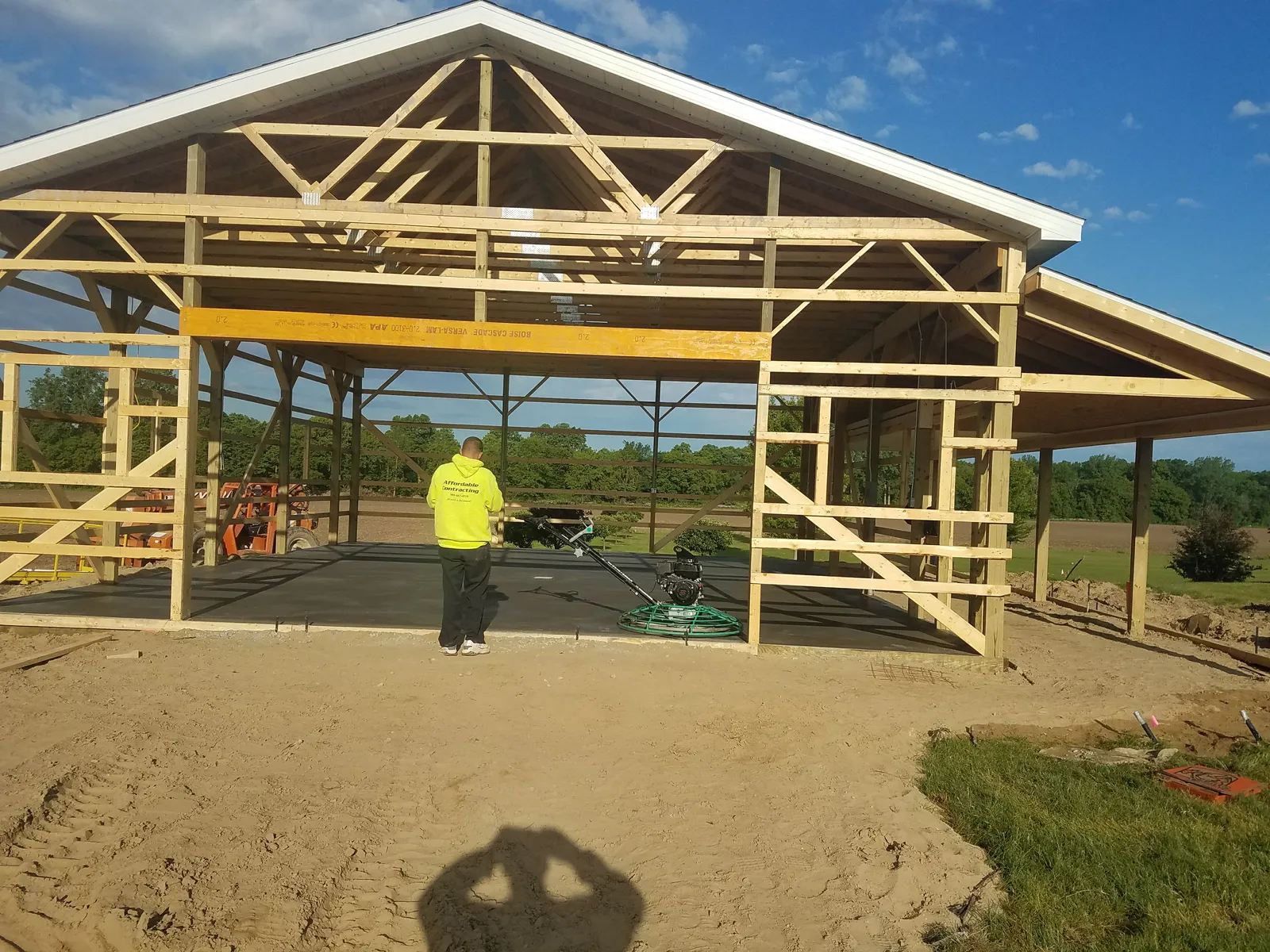
A pole barn is only as good as the floor you park on. Whether you are building a shop, equipment storage, or an ag building near Bay City or Midland, the concrete slab decides how it drains, how it handles heavy loads, and how it survives Michigan frost. Here is what to plan before the trucks roll.
How a post-frame slab is different
In post-frame (pole barn) construction, the building is supported by posts set into the ground, not by the slab. That means the concrete floor is usually a floating slab poured inside the post perimeter — it carries the floor loads but not the roof. This is simpler and more economical than a full foundation, but it puts all the more importance on the base prep, thickness, and edges, since the slab is doing its own structural job.
Slab thickness: match it to the load
Thickness is the first decision, and it should be driven by what will sit on or roll across the floor.
| Use | Recommended thickness | Notes |
|---|---|---|
| Storage, hobby, light vehicles | 4 inches | Standard for general use |
| Workshop with light equipment | 5 inches | Adds margin for point loads |
| Tractors, trucks, heavy equipment | 6 inches | Reinforced; consider thicker pads |
| Hoists, large machinery | 6+ inches | Often needs engineered pads |
A common mistake is pouring a 4-inch floor and then parking a loaded grain wagon or skid steer on it. When in doubt for an ag or shop building, go thicker — the extra concrete is cheap compared to cracking and replacement.
Reinforcement
Reinforcement controls cracking and helps the slab carry concentrated loads:
- Wire mesh is the minimum for light-duty floors.
- Rebar on a grid is preferred for shops and equipment storage, especially at 5–6 inches.
- Fiber-reinforced concrete can supplement steel to reduce shrinkage cracking.
Reinforcement must be positioned in the slab, not lying on the ground, so it actually does its job.
The vapor barrier: do not skip it
Bare ground constantly releases moisture. Without a barrier, that vapor moves up through the slab, leaving a floor that "sweats," rusts stored equipment, and ruins any future coating. Always install a vapor barrier — typically 10–15 mil poly sheeting — over the compacted base before the pour. This is essential for any heated, insulated, or finished shop, and cheap insurance even for cold storage.
Base prep and drainage
The slab is only as stable as what is under it:
- Compacted granular base. A well-compacted layer of crushed gravel or sand provides drainage and uniform support so the slab does not settle unevenly.
- Grade away from the building. Site grading should carry surface water away from the barn so it does not undermine the base or pool at the doors.
- Interior slope. A slight slope toward the overhead door (about an eighth of an inch per foot) lets snowmelt and washdown water drain out instead of pooling.
- Floor or trench drains can be built in for wash bays or heated shops.
Thickened edges and frost
This is where Michigan's climate earns its respect. Two details matter most:
Thickened edges
The slab perimeter and any door openings carry the most concentrated load — that is where vehicles roll on and off. Pouring a thickened edge (a deeper section of concrete around the perimeter and at door openings, often 8–12 inches deep) strengthens those high-stress zones and resists cracking and curling.
Frost considerations
In our region, frost can drive 3–4 feet deep. A floating slab that sits above the frost line can be lifted by frost heave if water collects under it. Defenses include:
- Good drainage so the base stays dry and water cannot freeze and expand beneath the slab.
- Air-entrained concrete to resist freeze-thaw surface damage.
- Insulation at the perimeter (rigid foam) for heated buildings, which helps protect against frost movement and energy loss.
- For some projects, thickened or frost-protected edges tie the floor and building together against heave.
Common uses across Mid-Michigan
Post-frame slabs serve a lot of needs in Bay, Midland, Saginaw, and Tuscola counties:
- Workshops for woodworking, mechanics, and fabrication.
- Equipment and vehicle storage for trucks, RVs, boats, and trailers.
- Agricultural buildings for implements, grain handling, and livestock support.
- Commercial and contractor storage for materials and fleet vehicles.
Each use points to a different thickness, reinforcement plan, and drainage layout — which is why planning the slab before the building goes up pays off.
Plan your slab with a local crew
The best time to get the slab right is before the building is even framed. Merchant American Concrete pours pole barn and post-frame floors throughout Bay, Midland, Saginaw, and Tuscola counties — including Pinconning, Linwood, Auburn, Kawkawlin, Sanford, Coleman, Caro, and Cass City. We will help you match thickness, reinforcement, vapor barrier, and drainage to how you will actually use the building. For a free estimate, call (989) 501-4525.