Thickness is the foundation of a driveway that lasts. Pour too thin and it cracks under load and heaves with frost; build it right and it can serve your home for decades. Here is how to choose the correct concrete driveway thickness for your vehicles and for Michigan's freeze-thaw climate.
The short answer
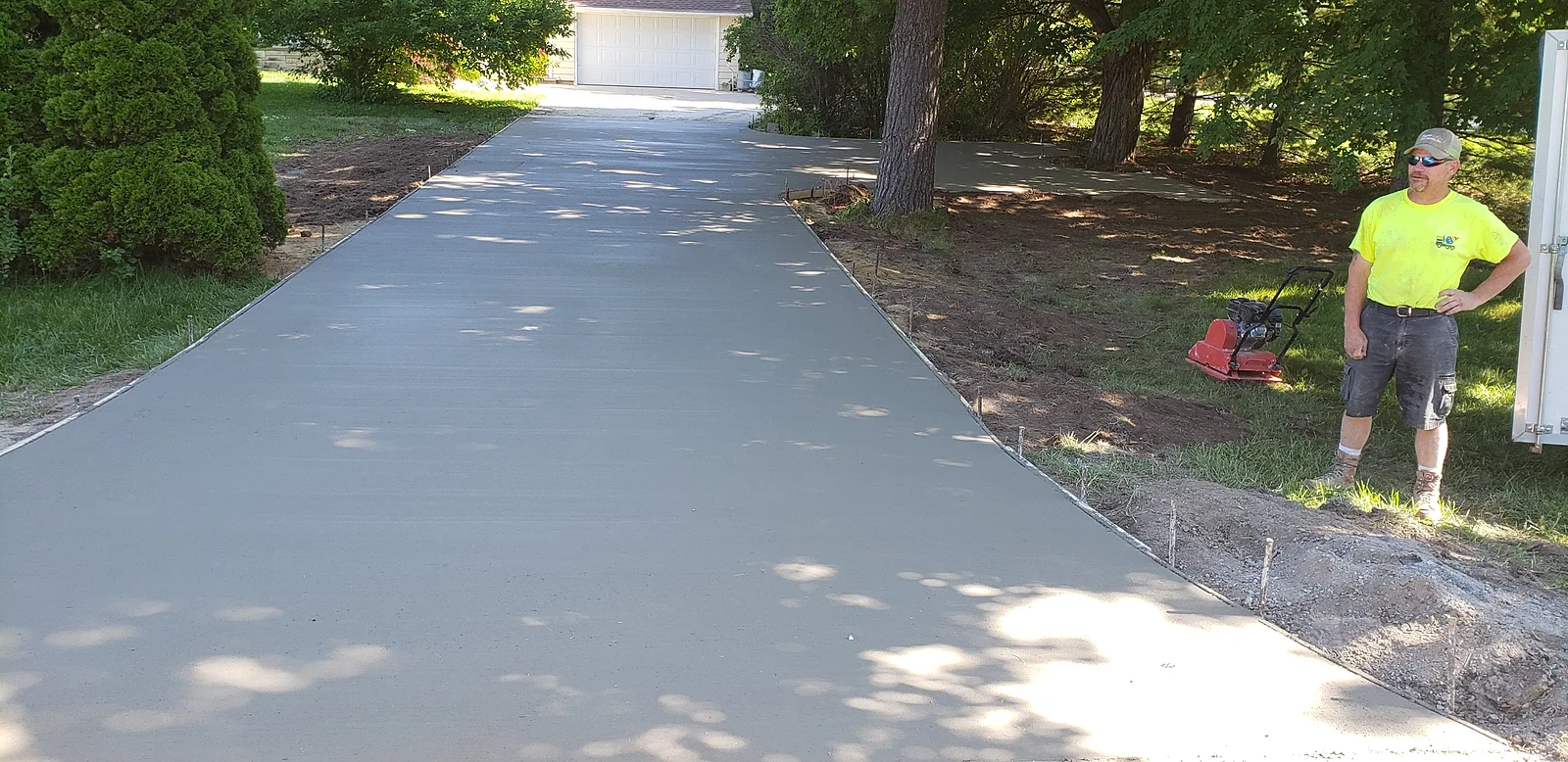
For a standard residential driveway carrying cars and light trucks, 4 inches of concrete is the proven standard. If you will park or drive heavier vehicles — RVs, loaded trucks, trailers, or work equipment — step up to 5 to 6 inches. That extra inch or two of concrete is inexpensive compared to the cost of repairing a cracked, undersized slab.
Thickness by use
| Driveway use | Recommended slab thickness |
|---|---|
| Standard cars & light trucks | 4 inches |
| Heavier pickups & frequent daily use | 4–5 inches |
| RVs, boats & large trailers | 5–6 inches |
| Loaded trucks & equipment | 6 inches |
| Approach / apron near the road | 5–6 inches |
Notice the apron — the section where the driveway meets the street — often deserves extra thickness because that is where the heaviest vehicles (delivery trucks, garbage trucks) cross.
Why thickness matters so much in Michigan
Concrete is extremely strong in compression but relatively weak in tension and bending. When a wheel load sits on a thin slab over soft or uneven ground, the slab flexes and cracks from the bottom up. A thicker slab spreads that load over more area and resists bending.
Then there is winter. Michigan's freeze-thaw cycles are brutal: water gets into the ground beneath and around the slab, freezes, expands, and lifts. This frost heave stresses the concrete repeatedly through every cold season from Bay City to Caro. A driveway that is too thin, poorly reinforced, or sitting on a weak base is far more likely to crack and shift under that pressure. Adequate thickness, combined with proper base prep and air-entrained concrete, is what keeps a Mid-Michigan driveway intact.
Thickness is only half the story: the base
A 6-inch slab on a bad base will still fail. Beneath the concrete you want a compacted gravel base, typically 4 to 8 inches deep depending on your soil. This base does two critical jobs:
- Spreads the load evenly so the slab is not bridging soft spots.
- Drains water away from under the slab, reducing the moisture available to freeze and heave.
Our clay-heavy soils in the Saginaw Valley hold water and move with frost, so a generous, well-compacted, free-draining base matters even more here than in sandier regions. Think of the slab and the base as one system: each is only as good as the other.
Reinforcement: holding it all together
Reinforcement does not make concrete thinner-but-equal; it makes a properly thick slab tougher and controls how it cracks over time.
- Rebar: steel bars on a grid add real structural strength. Standard for driveways, especially at 5–6 inches and where heavy vehicles park.
- Wire mesh: helps hold lighter residential slabs together and limit crack width.
- Fiber: mixed into the concrete to reduce early shrinkage cracking; a useful complement, not a full substitute for rebar or mesh.
Reinforcement should sit in the middle of the slab's depth, not on the ground, so it actually does its job.
Control joints: telling cracks where to go
All concrete cracks eventually — the goal is to control where. Control joints are grooves cut or tooled into the slab at planned spacing (commonly every 8 to 12 feet for a 4-inch driveway) so that shrinkage and stress cracks form neatly along those lines instead of randomly across the surface. Skipping or misplacing joints is a leading cause of ugly, uncontrolled cracking. A good crew plans the joint layout before the pour.
Putting it together
A driveway built to last in Mid-Michigan combines several things working as a system:
- Correct thickness for your vehicles (4 inches standard, 5–6 inches for heavy use).
- A compacted, free-draining gravel base of adequate depth.
- Rebar or mesh placed at mid-slab.
- Air-entrained concrete at a suitable PSI for exterior freeze-thaw exposure.
- Control joints at proper spacing.
Get those five right and thickness pays off; get the thickness right but skip the base or the air entrainment and you are back to early cracking.
Get your driveway built right
Not sure whether your project calls for a 4-inch or 6-inch slab, or how deep your base should be over local soils? Merchant American Concrete builds driveways for the freeze-thaw reality across Bay, Midland, Saginaw, and Tuscola counties, from Essexville and Auburn to Freeland and Frankenmuth. Call (989) 501-4525 for a free estimate and we will spec the right thickness for how you actually use your driveway.