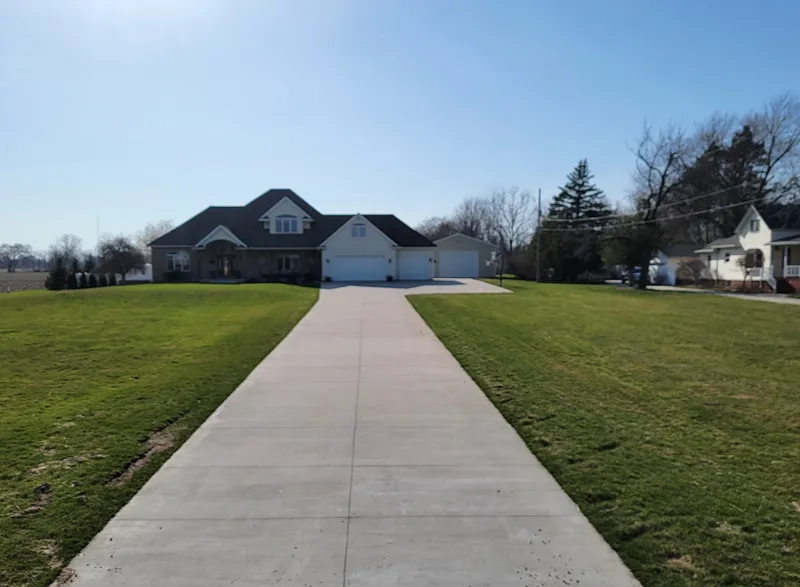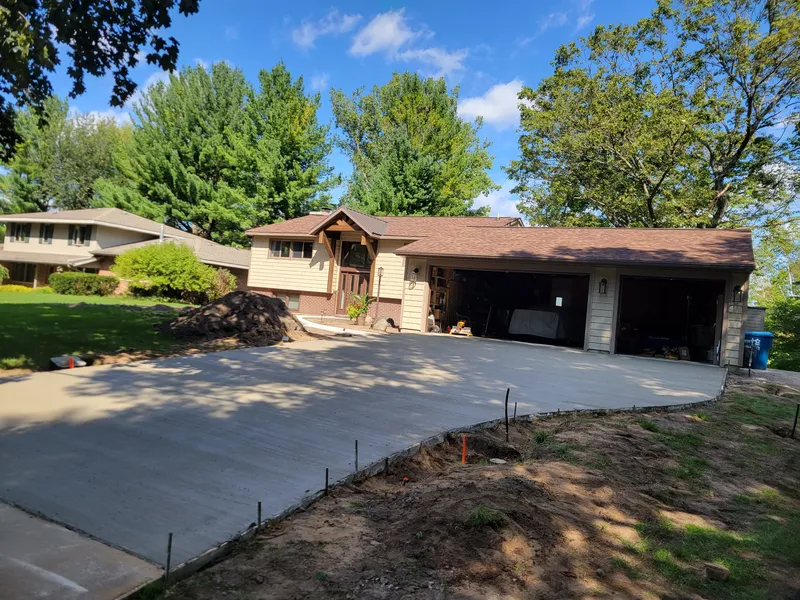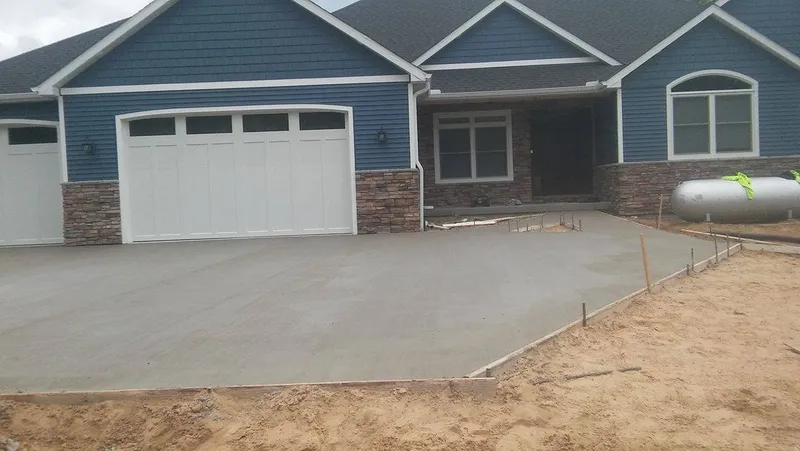
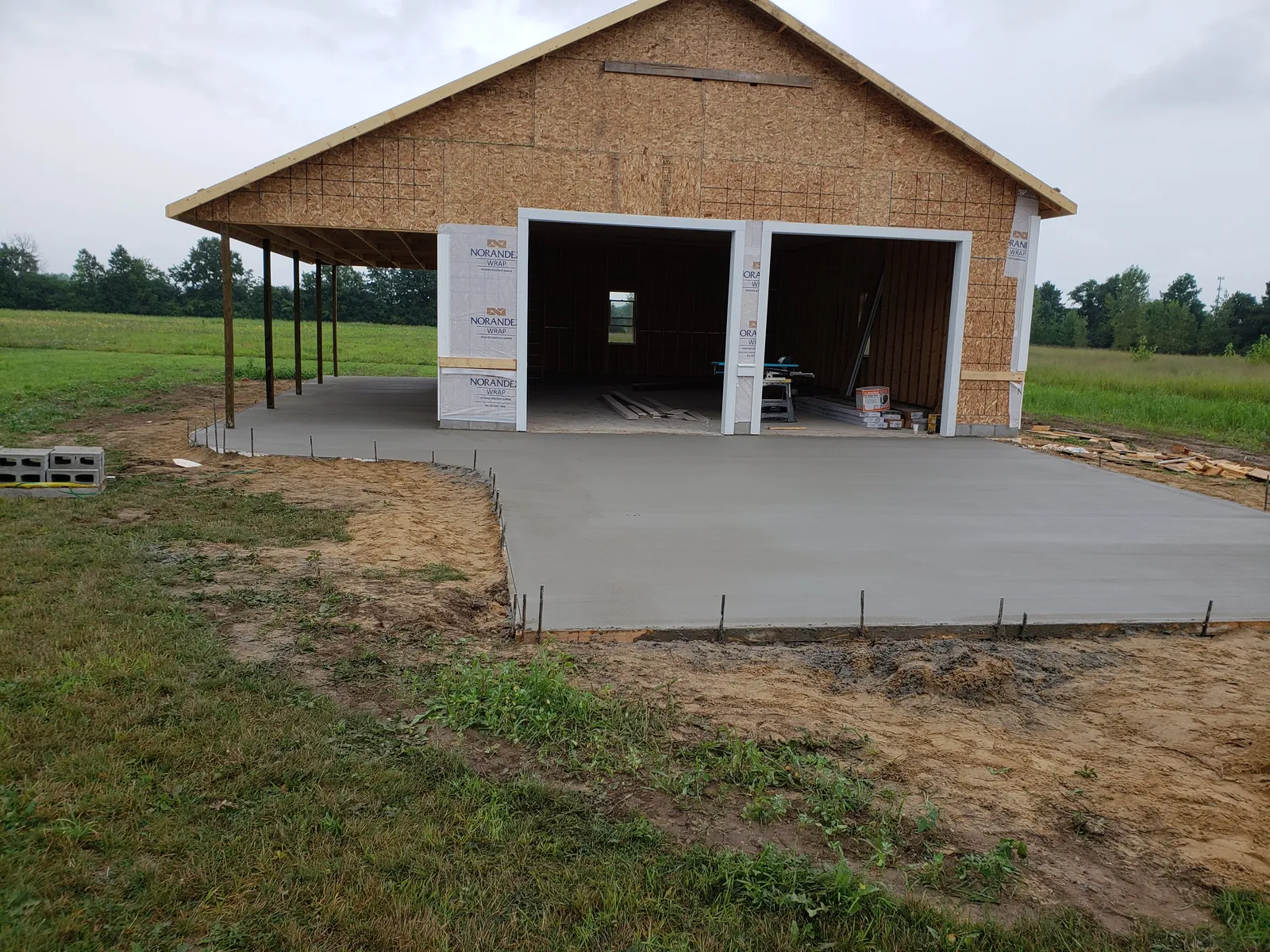
A garage floor takes more abuse than almost any slab on your property — vehicle weight, road salt, oil, and Michigan freeze-thaw all at once. This guide breaks down what a concrete garage floor costs in 2026, the finishing options worth considering, and the base and moisture details that decide how long it lasts.
What does a concrete garage floor cost?
In Mid-Michigan, a concrete garage floor typically runs $6–$12 per square foot installed in 2026, depending on thickness, finish, and any coatings. A plain, sealed slab sits at the low end; a polished or coated floor lands higher.
| Garage size | Approx. square feet | Cost at $6/sq ft | Cost at $12/sq ft |
|---|---|---|---|
| Single-car | ~240 sq ft | $1,440 | $2,880 |
| Two-car | ~440 sq ft | $2,640 | $5,280 |
| Three-car | ~720 sq ft | $4,320 | $8,640 |
These figures assume a new pour over a prepared base. If we are tearing out a failing floor or fixing drainage and grade, expect added cost for removal and prep.
How thick should a garage floor be?
Thickness is the foundation of a floor that will not crack under load:
- 4 inches is the standard minimum for passenger cars and light trucks.
- 5–6 inches is smart if you will park heavy trucks, an RV, a boat trailer, or use a floor jack and equipment.
- Reinforcement with wire mesh or rebar helps control cracking, and air-entrained concrete is essential for our freeze-thaw climate, since vehicles track in snow and salt all winter.
Control joints are cut into the slab so that any cracking happens in straight, hidden lines instead of randomly across the floor.
Finishing and coating options
The bare slab is just the starting point. Here is how the common finishes compare in Mid-Michigan.
| Finish / coating | What it is | Added cost (per sq ft) | Best for |
|---|---|---|---|
| Penetrating sealer | Soaks in, repels water and salt | $0.50–$2 | Budget protection, basic shops |
| Epoxy coating | Thick, glossy bonded layer | $3–$7 | Clean look, hobby garages |
| Polyaspartic coating | Fast-curing, UV-stable, very tough | $5–$9 | Daily-use, cold-weather garages |
| Polished concrete | Mechanically ground and densified | $3–$8 | Showroom floors, low maintenance |
Sealing
The most affordable protection is a penetrating sealer. It will not change the look much, but it repels water, oil, and de-icing salt that would otherwise drive freeze-thaw damage and staining. Reapply every few years.
Epoxy coatings
Epoxy bonds to the concrete and creates a hard, glossy, easy-to-clean surface that resists oil and chemicals. It is popular for its showroom look. The trade-off: epoxy can be slow to cure, is sensitive to moisture during application, and can yellow or peel if the slab was not prepped and dry.
Polyaspartic coatings
Polyaspartic is the upgrade many Mid-Michigan owners choose. It cures fast (often a one-day install), tolerates cold temperatures, resists UV yellowing, and shrugs off road salt and hot tires. It costs more than epoxy but generally lasts longer in a working garage.
Polished concrete
Grinding and densifying the slab produces a smooth, durable, low-maintenance surface with no coating to peel. It reflects light well and is easy to sweep, though it offers less chemical resistance than a coating.
Drainage and slope
A garage floor should be poured with a slight slope toward the door (about an eighth of an inch per foot) so that snowmelt, washdown water, and tracked-in slush drain out instead of pooling. For heated shops or wash bays, a trench drain or floor drain can be built in. Standing water on a garage floor accelerates freeze-thaw damage and rusts whatever sits on it, so getting the grade right is one of the most important details we plan up front.
Moisture control matters
Coating failures are usually moisture failures. Concrete in contact with the ground can wick up water vapor, and that vapor pressure pushes coatings loose from below. To prevent it:
- Install a vapor barrier (poly sheeting) under the slab during the pour.
- Make sure the base drains well and the grade directs water away from the building.
- For coatings, the slab must be fully cured and tested for moisture before application.
Getting these basics right is the difference between a coating that lasts a decade and one that peels in a year.
Build it for Michigan from the ground up
Whether you want a simple sealed slab or a polyaspartic-coated showroom floor, the slab underneath has to be poured correctly: right thickness, reinforcement, air-entrained mix, proper slope, and a vapor barrier. Merchant American Concrete pours and finishes garage floors across Bay, Midland, Saginaw, and Tuscola counties — from Bay City and Essexville to Midland, Saginaw, Auburn, and Frankenmuth. For a free estimate on your garage floor, call (989) 501-4525.