The challenge in Caro
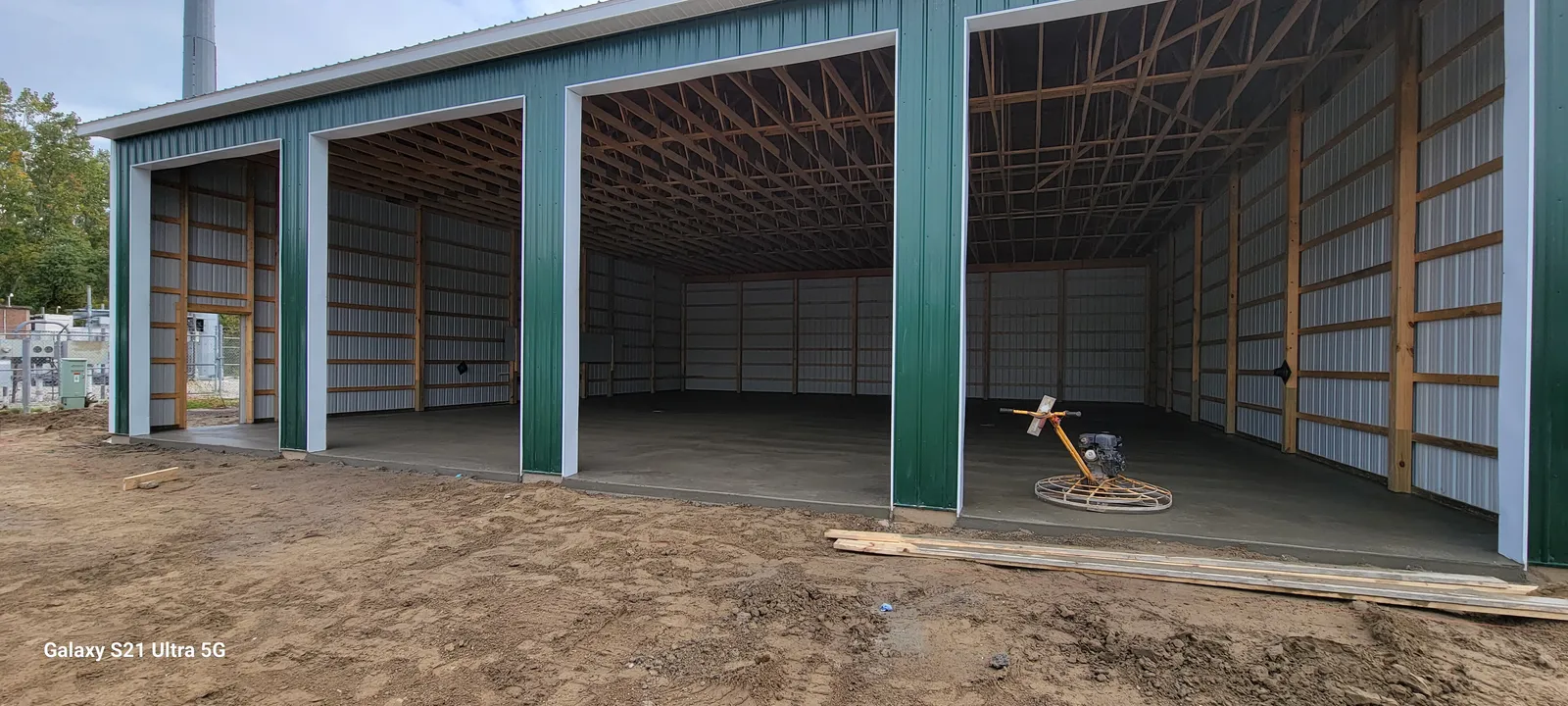
A Tuscola County farmer needed a 40×60 post-frame building floor poured before the building was sided, so the slab could be machine-finished without forklifts and overhead doors getting in the way. The floor had to handle a tractor, equipment storage, and occasional shop work — meaning vapor protection, surface flatness, and freeze-thaw durability all mattered.
What we built in Caro
We surveyed the existing pad, regraded for fall to a single drain location, and laid 6 inches of compacted limestone over a 10-mil vapor barrier with taped seams. Skipping the vapor barrier on a barn floor is one of the most common mistakes we see during repair calls — moisture rolls up through the slab in spring and rusts everything stored on it.
We saw-cut the slab into 12×12 bays the day after the pour to control where any shrinkage cracking would occur. Where the door tracks land, the slab was thickened to 6 inches and reinforced with #4 rebar.
A 4,500 PSI air-entrained mix with macro-fiber reinforcement gave us crack control without the cost of a full rebar mat over 2,400 square feet. We power-troweled to a hard, slick finish that the owner can sweep clean and seal in spring.
The pour was timed for late October before the first frost. With a cold-weather admixture and curing blankets pulled tight against perimeter framing, we hit our 28-day strength on schedule and signed off the floor before snow flew.
The outcome in Caro
The slab took its first winter without a heated floor without cracking or scaling, and the owner reports no spring moisture coming up under stored equipment — exactly what the vapor barrier and air-entrained mix were specified for.